If you've been following me, you might remember a post about a breast feeding campaign in Mexico City that was rather controversial. If you haven't heard about it, you can read my original article here.
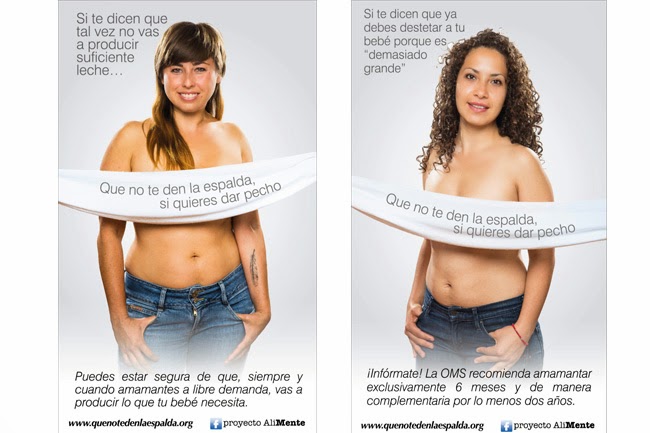
Well, a group called Proyecto Alimente, an NGO aimed at promoting nutritional information and good eating in Mexico, has launched a counter-campaign. This campaign promotes images of bodies of real women who breast feed. It also features (in my humble opinion), better information about the myths and facts of breast feeding, while still talking about the stigma that women suffer from breast feeding in public.
I guess I have lived in the countryside for a long time now, since I don't see this stigma around, but apparently it's pretty strong (although I suspect not as strong as the stigma in the US) in the cities.
Anyway, what do you think? Is this campaign better than the original one? Do you think real bodies like these should be featured more in the media? Let us know in the comments.
---
Robert Ervin is a freelancer who writes about healthcare, medical
tourism, and living in Mexico.
If you're considering traveling to Mexico for healthcare or retiring in
Mexico, you may want to consider getting yourself a copy of The English's Speaker's Guide to Doctors and Hospitals in Mexico, in order to find a good doctor or hospital in the main towns and cities of Mexico, or The English Speaker's Guide to Medical Care in Mexico, to understand how the Mexican healthcare system works.
Showing posts with label women's image. Show all posts
Monday, June 16, 2014
Friday, May 30, 2014
Breast Feeding Campaign in Mexico Causes Controversy
Every doctor will tell you that breast feeding is the best way to feed a baby. In Mexico, for the most part, breast feeding has been a natural process that is socially acceptable for centuries.
In the country side and in small cities, it is normal to see women breastfeeding their babies pretty much anywhere. They frequently cover themselves with a small blanket or a rebozo, a long flat scars that has many uses. One of them is to carry their child on their backs and have both hands free, often because these women are working or carrying things around. It is seen as perfectly normal and nobody bats an eye when it happens. In small cities, the blanket (often with images of baby-related icons) is more common than the rebozo, but the situation is pretty much the same.
If women get out of sight to breastfeed their children, it is just because they need a place to sit down and the seats just happen to be out of the way. That's why breastfeeding is not a rare sight in restaurants.
The big cities are a different matter. With an increase in the number of of middle class women, who tend to be more self-conscious about it, but also work in areas where they can't have their babies with them, such as corporate offices, the practice of breastfeeding is dissapearing. In Mexico City, the most populous city in the world, the government launched a campaign to promote breastfeeding.
However, the campaign has been heavily criticized. The main complaints are the way women are portrayed in it. Critics say that the images are too sexualized, don't have anything to do with breastfeeding, represent an unrealistic image of women (specially mothers), and are too white for a country where more than 93% is mestizo (descendants of Europeans and indigenous people).
I'm showing the images at the top of the article. What do you think? Are the critics right? Or is it a good campaign? Moreover, what do you think about the Mexican way of breastfeeding in public?
Whether you're planning to retire or visit Mexico, it's important to understand the cultural differences between Mexico and your own country. Here's the story of a woman that decided to live in Mexico and loves the Mexican way.
--
Robert Ervin is a freelancer who writes about healthcare, medical tourism, and living in Mexico.
If you're considering traveling to Mexico for healthcare or retiring in Mexico, you may want to get yourself a copy of The English's Speaker's Guide to Doctors and Hospitals in Mexico, in order to find a good doctor or hospital in the main towns and cities of Mexico, or The English Speaker's Guide to Medical Care in Mexico, to understand how the Mexican healthcare system works.
In the country side and in small cities, it is normal to see women breastfeeding their babies pretty much anywhere. They frequently cover themselves with a small blanket or a rebozo, a long flat scars that has many uses. One of them is to carry their child on their backs and have both hands free, often because these women are working or carrying things around. It is seen as perfectly normal and nobody bats an eye when it happens. In small cities, the blanket (often with images of baby-related icons) is more common than the rebozo, but the situation is pretty much the same.
If women get out of sight to breastfeed their children, it is just because they need a place to sit down and the seats just happen to be out of the way. That's why breastfeeding is not a rare sight in restaurants.
The big cities are a different matter. With an increase in the number of of middle class women, who tend to be more self-conscious about it, but also work in areas where they can't have their babies with them, such as corporate offices, the practice of breastfeeding is dissapearing. In Mexico City, the most populous city in the world, the government launched a campaign to promote breastfeeding.
However, the campaign has been heavily criticized. The main complaints are the way women are portrayed in it. Critics say that the images are too sexualized, don't have anything to do with breastfeeding, represent an unrealistic image of women (specially mothers), and are too white for a country where more than 93% is mestizo (descendants of Europeans and indigenous people).
I'm showing the images at the top of the article. What do you think? Are the critics right? Or is it a good campaign? Moreover, what do you think about the Mexican way of breastfeeding in public?
Whether you're planning to retire or visit Mexico, it's important to understand the cultural differences between Mexico and your own country. Here's the story of a woman that decided to live in Mexico and loves the Mexican way.
--
Robert Ervin is a freelancer who writes about healthcare, medical tourism, and living in Mexico.
If you're considering traveling to Mexico for healthcare or retiring in Mexico, you may want to get yourself a copy of The English's Speaker's Guide to Doctors and Hospitals in Mexico, in order to find a good doctor or hospital in the main towns and cities of Mexico, or The English Speaker's Guide to Medical Care in Mexico, to understand how the Mexican healthcare system works.
Subscribe to:
Posts (Atom)

