Doctors and Hospitals in Mexico

Showing posts with label americans traveling to Mexico for dental care. Show all posts

Wednesday, July 2, 2014

Full Mouth Reconstruction in Mexico

Unfortunately, some people lost all or some of their teeth. The most common cause for tooth loss in adults is gum disease. However, some people lose their teeth as a result of an accident, age, genetics, or a combination of factors.

Today, we have the technology, the knowledge, and the materials to give back a functional mouth to people who have lost their teeth in a way that's practically indistinguishable from natural teeth. These solutions are commonly known as full mouth restorations, and they involve one or more dental procedures.

Sadly, in the United States, many people aren't even offered full mouth restorations as an option. Why? It's not that full mouth restorations aren't available in the United States, but that the price for them is so high, that they are unavailable for the majority of people, and thus many American dentists don't even think full mouth restorations are a feasible option for their patients. 

As a result, many patients in the US get dentures because they don't know about full mouth restorations or they can't afford them. Now, in some cases, dentures are the best option due to health issues. But this is not always the case.

On the other hand, most Americans can and get full mouth restorations at affordable prices in Mexico. Mexican dentists do offer these solutions to all patients. Note that it's not that American dentists are neglectful, but that they know from experience that such solutions are out of the financial reach of their patients and they don't want to give them expectations that they just can't get.

But what do full mouth restorations involve? Because each patient's situation is different, there is no standard procedure, like with a root canal. Rather, each patient has to be evaluated, typically through X-rays, visual examination, and other tests, before a solution can be offered. Some of the most common ones are:

Implants
Veneers
All-in-four
Crowns
Bridges
Extractions (for teeth that are so damaged that they can't be saved)

--

Robert Ervin is a freelancer who writes about healthcare, medical tourism, and living in Mexico.

If you're considering traveling to Mexico for healthcare or retiring in Mexico, you may want to get yourself a copy of The English's Speaker's Guide to Doctors and Hospitals in Mexico, in order to find a good doctor or hospital in the main towns and cities of Mexico, or The English Speaker's Guide to Medical Care in Mexico, to understand how the Mexican healthcare system works.



Sunday, June 8, 2014

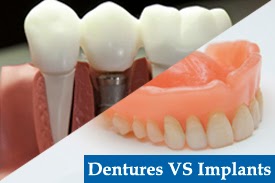
Dentures or Implants?

When a patient has lost all of his teeth, he basically has two options, to get dentures or to get implants.

The answer is simple. Implants are the better choice in patients who are relatively healthy. Implants offer more benefits than dentures in the long run. However, in a few cases, the reverse is true. For comparison purposes, here are the advantages and disadvantages of dentures and implants:

Dentures

Pros:
  • They're cheaper than implants
  • They're simple to use
  • They don't require surgery
  • They require less visits to the dentist and less waiting time than implants

Cons:
  • They are removable
  • They might cause embarrassment if a patient has to take them out in public for some reason
  • They don't feel as natural as implants

Implants

Pros:
  • They are very stable
  • They have the full strength of the jaw
  • They are fixed
  • They require little care
  • They feel almost like natural teeth

Cons:
  • They require one or two surgeries
    In a few rare cases, they may require a hospital-based surgery to get bone from the hip and transplant it to your jawbone
    The procedure takes a few months
    They are expensive
    Some conditions, like diabetes, might prevent you from getting them
You may have notices that all factors in these lists are health related, except for the cost. Unfortunately,  implants are expensive and when several ones are required, the cost makes them unavailable to many American patients. This is why they cross the border into Mexico. They can get here the implants they need at prices they can actually afford. They don't have to settle for small-clinics either, not that there's anything wrong with them. They can go to the best institutions and pay for the plane ticket and hotel and it would still be cheaper than having the treatment in the USA.

--

Robert Ervin is a freelancer who writes about healthcare, medical tourism, and living in Mexico.

If you're considering traveling to Mexico for healthcare or retiring in Mexico, you may want to get yourself a copy of The English's Speaker's Guide to Doctors and Hospitals in Mexico, in order to find a good doctor or hospital in the main towns and cities of Mexico, or The English Speaker's Guide to Medical Care in Mexico, to understand how the Mexican healthcare system works. 

Monday, June 2, 2014

Health Care in Mexico: Root Canals

Many Americans go to Mexico for inexpensive dental care. However, the savings have to be considerable in order to make the trip. Dental implants and complex restorations are usually worth the price. Other procedures, like fillings, not so much.

Root canals are unique in the sense that they fall in some sort of middle ground where it's very uncertain whether or not it's a good idea to make the trip. However, for Americans that live in California, Texas, and Arizona, the distance is short enough that it's definitely worth it.

A root canal is a procedures used when a tooth infection has developed so much that it has infected the nerve, but the tooth still has enough good portions that it can be saved. The infections may be caused by periodontal disease or trauma. It is strongly recommended to take care of it as soon as possible, because it can be quite painful if it's left untreated.

The procedure involves the dentist drilling through the tooth and extracting the nerve. He then disinfects the canal where the nerve was, and fills it with a special type of dental cement. Depending on the severity of the damage, the dentist restores the tooth with a filling or a crown.

It's worth to notice that the technological advancements, both in equipment and in anesthetics, have made the procedure much less painful than in the past. The procedure takes about 20 minutes. If the tooth needs a crown, the dentist will leave a temporary filling while the crown is manufactured.

If you're like to read about implants, a dental procedure that makes the trip to Mexico worthwhile, go here.

--

Robert Ervin is a freelancer who writes about healthcare, medical tourism, and living in Mexico.

If you're considering traveling to Mexico for healthcare or retiring in Mexico, you may want to get yourself a copy of The English's Speaker's Guide to Doctors and Hospitals in Mexico, in order to find a good doctor or hospital in the main towns and cities of Mexico, or The English Speaker's Guide to Medical Care in Mexico, to understand how the Mexican healthcare system works. 

Monday, May 26, 2014

The Importance of Getting Dental Care NOW

Don't wait until it's too late
I have written a lot about many Americans have been going to Mexico to get health care at a lower price. That's a choice that many people make and it's as valid as getting your health care in the United States.

Today I'm going to write a bit about how important it is to get dental care NOW.

Basically, if you need dental care, it doesn't matter whether you get it in the United States or in Mexico. What matters is that you have to get it as soon as possible.

Many people postpone dental care because it's expensive. However, when a dental problem goes untreated, it will just get irreparably worse. This means that eventually the treatment will be more complex and more expensive. Not to mention that the whole experience will be more painful. If you need a filling now, and you postpone it, by the time you go to the dentist, you may need a crown, which is significantly more expensive. If you keep postponing it, then you will lose the tooth, and will need an extraction and a bridge. Or an implant. And by then the infection may have extended to other teeth, meaning you'll need a solution that involves several implants.

The whole thing will be more expensive, you'll lose your natural teeth, and of course, you will have to spend extra money to buy drugs to keep the pain under tolerable levels.

And it can all be avoided if you go to the dentist now.

Initially, I wanted to base this article on a study that Aspen Dental ordered and that was carried out by ORC International. The study was about how lower expected incomes and the idea that dental care was not crucial was causing Americans to postpone dental care until it was too late. However, I tried to find it, and while I found several references to it, I didn't find the study. So, I cannot confirm that these claims are true.

Anyway, please, if you need dental care. Go get it today, whether in Mexico or the US. Your teeth and your wallet will thank you.

---


Robert Ervin is a freelancer who writes about healthcare, medical tourism, and living in Mexico.

If you're considering traveling to Mexico for healthcare or retiring in Mexico, you may want to get yourself a copy of The English's Speaker's Guide to Doctors and Hospitals in Mexico, in order to find a good doctor or hospital in the main towns and cities of Mexico, or The English Speaker's Guide to Medical Care in Mexico, to understand how the Mexican healthcare system works.

Friday, May 23, 2014

Dental Care in Mexico: Understanding Implants

The 3-steps involved in a dental implant.
There are many Americans that travel to Mexico for a very specific type of health care: dental care. This is specially true for Americans that live close to the border.

The main drive is without a doubt the lower cost. For many Americans, some dental procedures are out of their financial reach or just too difficult to afford. However, before going to Mexico, you should inform yourself about the specific procedure you want to have. Today, I'm going to write about implants.

Implants are one of the best ways to replace lost teeth. They offer the stability, the strength, the feel, and the appearance of regular teeth. They last for very long and they practically are indistinguishable from natural teeth. Unfortunately, they're expensive. Also, you won't be able to get one in only one visit.

The process starts with tests and x-rays to establish whether you're a good candidate for the procedure. Once the decision has been made, a date is set for surgery. On this day, the dentist will pull out any remains of the tooth and insert an implant, which is a small device that will anchor the tooth to the bone.

After the surgery, you'll have to wait a few weeks or even months (expect at least 3 months). During this time, the wounds will heal, but most importantly, the implant will fuse itself with the jawbone, in a process called osseointegration. This process is what gives the implant stability and strength.

A second surgery is then needed. During this second surgery, the top of the healed gum will be opened and an abutment placed on the implant. Sometimes, this second surgery is performed at the same time than the first one, in order to avoid two different surgeries at different times, especially when dealing with international patients. In any case, the patient will have to wait for the wounds to heal again, although the wait will be much shorter.

Finally, in the third visit, a crown or another artificial tooth will be placed and set on top of the abutment.

Unlike other procedures, an implant needs at least two visits separated by a considerable amount of time. If you want to travel to Mexico to get one or more dental implants, you should consider this factor, and also take into account that your own dental development might unexpectedly delay your second or third visit. For example, if the osseointegration hasn't been achieved by the expected date, your second visit will have to be postponed.

Finally, the success rate of implants is very high, but not completely 100%. Some bodies reject the implant as a foreign body. There are other risks that will depend on your specific circumstances. You should talk to your doctor about them before making a decision.

How do you feel about Americans traveling to Mexico for health care? Tell us in the comments. Also, read about the ranking of the US health care system, compared to other countries. Or whether it's safe or not to travel to Mexico.

---

Robert Ervin is a freelancer who writes about healthcare, medical tourism, and living in Mexico.

If you're considering traveling to Mexico for healthcare or retiring in Mexico, you may want to get yourself a copy of The English's Speaker's Guide to Doctors and Hospitals in Mexico, in order to find a good doctor or hospital in the main towns and cities of Mexico, or The English Speaker's Guide to Medical Care in Mexico, to understand how the Mexican healthcare system works.